



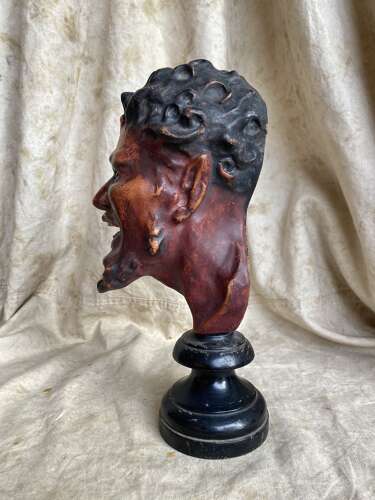



An antique late 19th century French plaster bust of a Faun or a Satyr
Code: 10227
Dimensions:
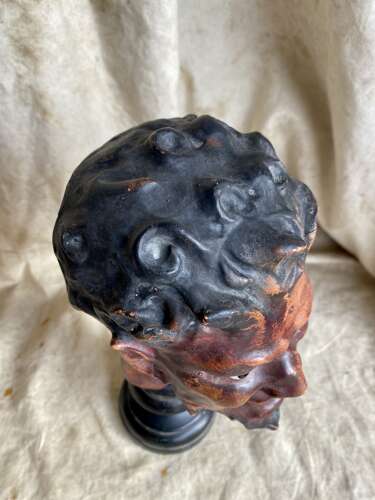
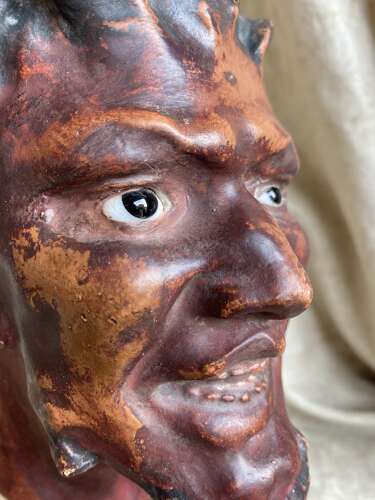
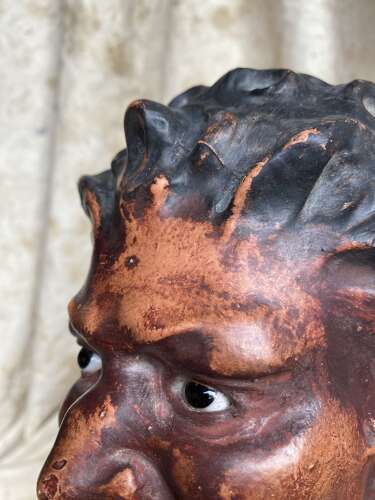
The late 19th century bust is well formed in plaster and hand painted, with inset glass eyes.
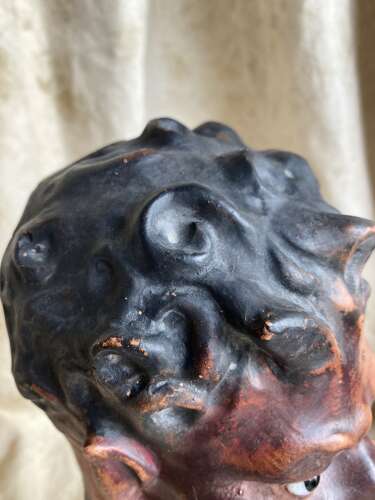
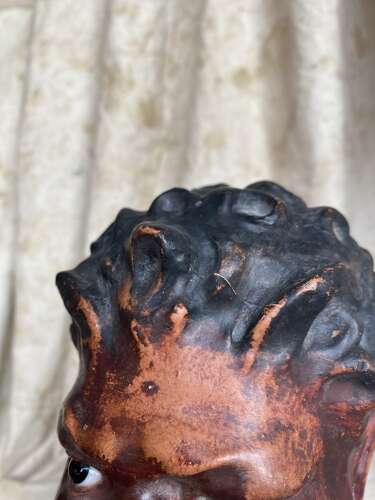
Formed with an open mouth poise, small horns protruding from the tight curls of hair on its head, with elongated ears and pointed beard. There are the distinctive side tuffs to either side of the jaw line, commonly seen in depictions of both the Satyr and Faun.
Their similarities mean it is hard to know which of the creatures this bust was intended to represent. Our personal thoughts are it was most likely the Faun, but this is obviously open to interpretation.
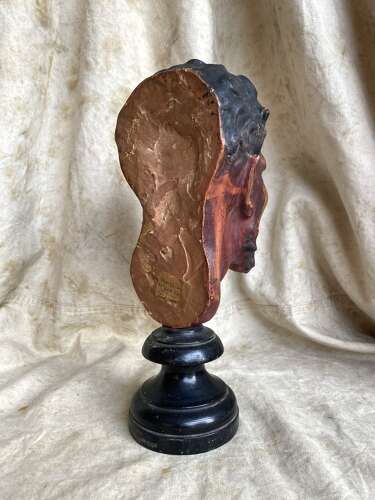
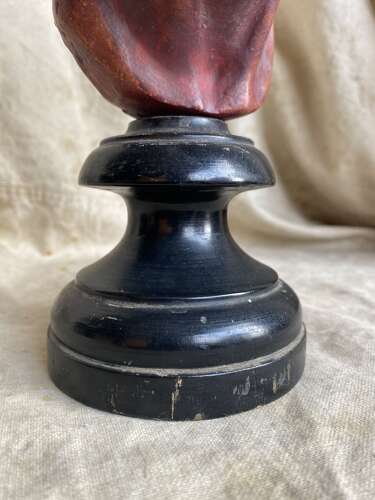
The bust is raised on an ebonised period turned wooden base.
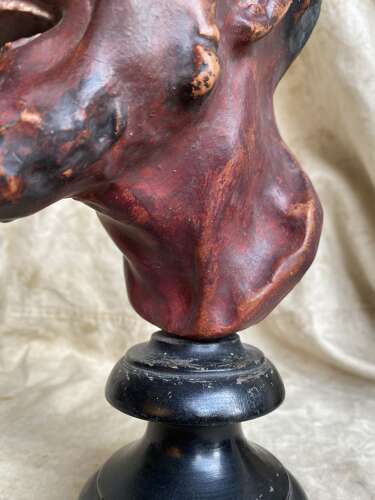
With a fantastic deep red colour and patina to the painted surface.
The accomplished modelling and glass eyes really bring the piece to life.
The Faun which classically is described as a half man, half goat with horns and elongated ears. With the iconography of the Satyr becoming conflated with that of Pan. By the Hellenistic period Satyrs were beginning to be shown with goat like features.
The name Faun is derived from Faunus, which was the name of an ancient Italic deity of forests, fields and herds. Faunus was also associated with the Greek god Pan, which explains the similar appearance in art and literature.
With some similarities in appearance to that of the Satyr, with the line between the two blurring over time, although originally these were very different creatures.
Greek mythology characterizes the Satyr as lovers of wine, music and woman. They were companions of the god Dionysus, and would often exhibit obscene behavior.
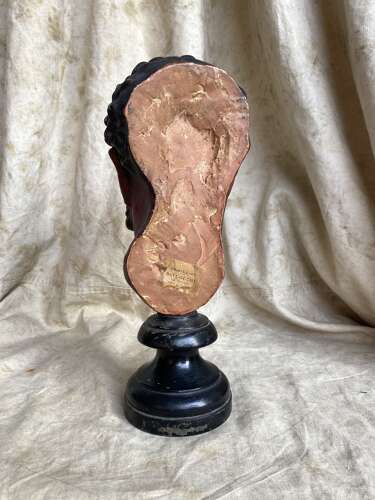
To the back of the bust is a paper label with the following inscription:
OBJECTS D’ART
BALDOCCHI
Rue Boulbonne
TOULOUSE
The name Baldocchi could possibly be reference to Théodore Baldocchi, a noted French artist and sculptor, who was born in Toulouse in 1868, and where he also exhibited. Although we cannot verify this unfortunately.
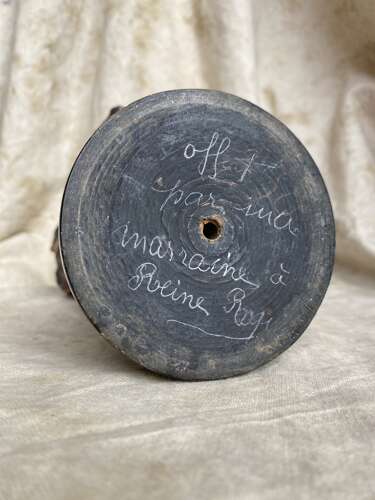
To the underside of the base is a French pencil inscription which when translated reads:
“Given by my godmother to Reine Roque”
Dimensions:
Height inc. stand – 31cm
Depth – 13cm
Width – 12.5cm
Base diameter – 9.7cm
Base height – 8.9cm
The piece survives very well with very little damage, bar small surface nibbles as illustrated.
The bust has a metal bar at its base which fits into the stand. Once fitted the piece stands very well. It also allows the bust to be turned around whilst the base remains stationary.
